
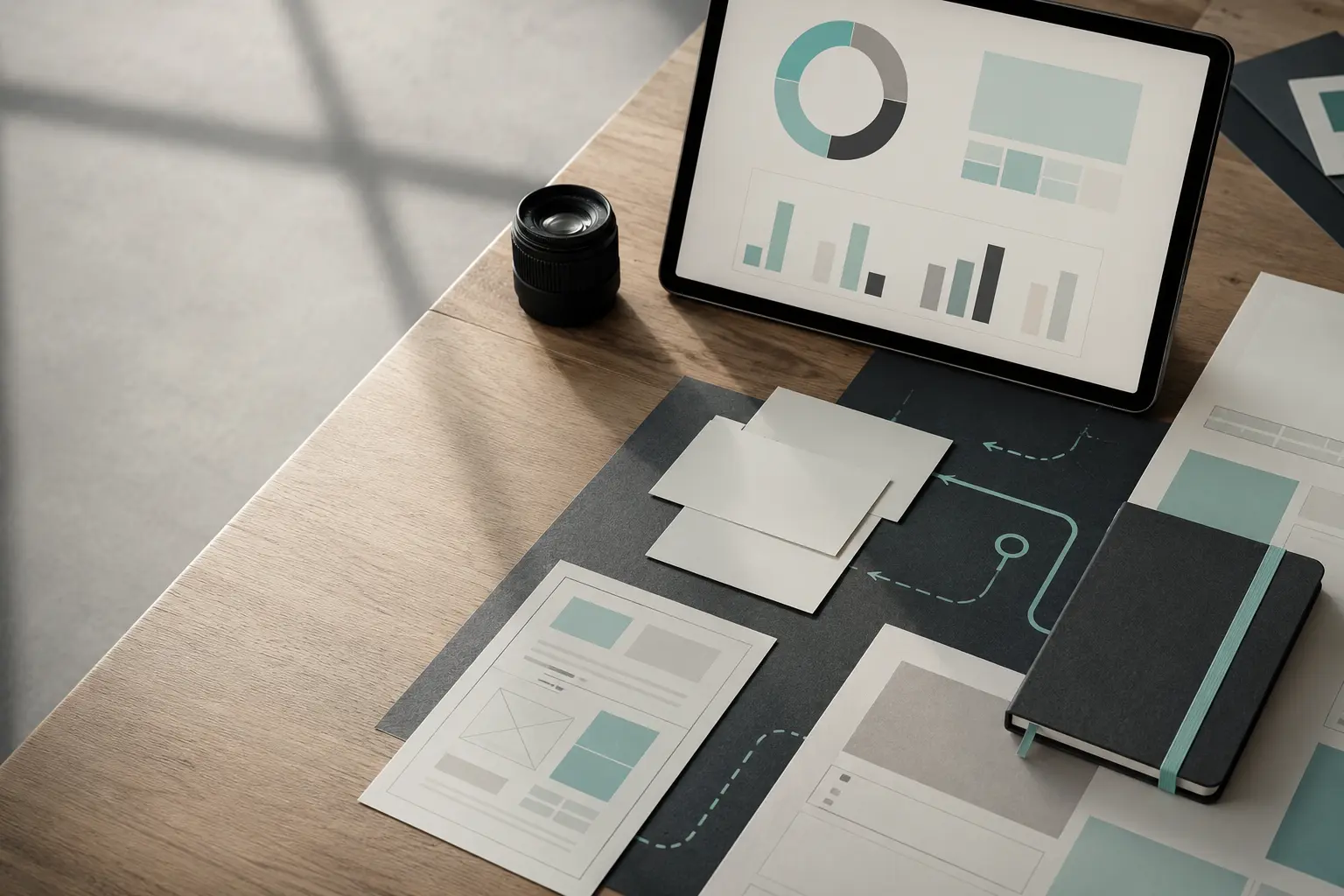
A business website should do more than look professional. It should help the right visitor understand the offer, decide whether it fits their needs and take a sensible next step. When those jobs are not clearly planned, even an attractive website can attract traffic without producing useful enquiries.
WordPress provides a flexible foundation, but the platform alone does not create results. Page structure, content, proof, performance and measurement must work as one system. This guide explains the practical decisions that make a service-led website easier to find, understand and use.
Begin with the customer journey, not the page design
Before choosing layouts, list the main audiences and the questions they need answered. A potential customer may want to know whether the service covers their location, whether the provider has relevant experience, what the process involves and what happens after contact.
Those questions should determine the site architecture. Important services normally need their own pages. Closely related supporting questions can become guides or FAQs, while genuine location demand may justify carefully differentiated local pages. Our WordPress web design service begins with this structure because visual styling is more effective when every page already has a clear purpose.
Give every commercial page one primary job
A strong service page focuses on one recognisable need. Its title, heading, opening copy and call to action should describe the same proposition. Trying to make one page rank and convert for every service often creates vague copy that satisfies neither visitors nor search engines.
Supporting articles can address narrower questions and link back to the commercial page. This creates a useful content relationship without forcing several URLs to compete for the same primary search intent. It also supports the page-ownership principles used in our SEO services.
Make the opening section immediately useful
The first screen should confirm what is offered, who it is for and what the visitor can do next. It does not need to contain every detail, but it should remove uncertainty. Generic statements about innovation or excellence are less useful than a direct explanation of the service and its practical outcome.
A clear heading, concise introduction and one primary action usually provide a stronger starting point than several equally prominent buttons. Secondary actions can still be available for visitors who need to review work, understand the process or read supporting information first.
Use evidence that matches the decision
Proof should help a visitor evaluate suitability. Depending on the business, useful evidence may include relevant case studies, qualifications, named experience, process detail, verified reviews, service coverage or examples of completed work.
Evidence must be accurate and appropriately qualified. A case study should explain the starting point, work undertaken and result that can genuinely be supported. Avoid presenting an isolated ranking or impression increase as a complete commercial outcome when lead quality or revenue has not been verified.
Design forms around a useful first conversation
A form should collect enough information for a relevant response without turning the first contact into a lengthy application. The right fields depend on the service. Project type, location, timescale and an open message may be valuable for a specialist provider, while an ecommerce journey may require a different action entirely.
Explain what happens after submission. A simple confirmation page and realistic response expectation reduce uncertainty. Contact Form 7 can support this journey when it is styled consistently, protected against spam and connected to dependable conversion measurement.
Protect mobile usability and page performance
Many visitors will encounter the website on a phone, even when the final decision happens later on another device. Headings must remain readable, buttons need adequate space and forms should be easy to complete. Navigation, telephone links and confirmation messages should all be tested on real mobile widths.
Large images, unnecessary scripts and complex animation can slow the page or cause elements to move while loading. Media should be appropriately sized and compressed, while decorative effects should not interfere with reading or interaction. Performance is not only a technical score; it affects whether a visitor can use the page confidently.
Connect the website to reliable measurement
A website cannot be improved responsibly if meaningful actions are not measured. Track confirmed form submissions, useful calls, bookings or purchases rather than treating every button click as a successful lead.
Our data analytics and conversion-tracking service helps connect website actions with GA4 and advertising platforms. This makes it possible to compare landing pages, identify broken journeys and understand where marketing activity contributes to genuine progress.
Keep WordPress editable without losing consistency
Editors should be able to update text, images and supporting sections without rebuilding the design. Reusable blocks, sensible defaults and a restrained set of layout choices make this easier. The goal is controlled flexibility: enough freedom to maintain accurate content, but not so many options that every page becomes visually unrelated.
Updates should also be managed carefully. Themes and plugins need maintenance, but changes should be backed up and tested so a routine update does not disrupt forms, tracking or page layouts.
Improve the website using real behaviour
After launch, review search queries, landing-page engagement, form completion and lead feedback together. If a page attracts relevant visits but few useful enquiries, the issue may be unclear scope, insufficient proof, friction in the form or a mismatch between the search promise and the page.
A high-performing website is not a one-time creative exercise. It is an editable commercial platform that becomes clearer as the business learns what customers need.
Planning a new website or improving an existing one? Contact STV Media Marketing to discuss the structure, content, WordPress build and measurement needed for a stronger enquiry journey.